
'The lesson Beijing would have learned is that there is, cost-benefit wise, no better option than to keep the Pakistan military supplied with its most advanced armaments, certain that in hostilities with India these would be used for maximum effect.'

The stats according to World Population Review's 2022 compilation.

Trump may strike. He may announce productive talks and extend again. He may do both at the same time. Iran will not open the Strait on someone else's terms, so no matter what happens, that problem will remain unsolved. And the IRGC will still be collecting its $2 million toll from every ship bold enough to ask permission to pass.

'Pakistan's role in Bangladesh will always be negative, since it's a one-point agenda is hostility against India.'

Pakistan's Army Chief Field Marshal Asim Munir met with Chinese President Xi Jinping, along with Pakistani Prime Minister Shehbaz Sharif, to discuss bilateral and regional cooperation. The meeting occurred during Sharif's visit to China for the Shanghai Cooperation Organisation (SCO) summit.

Pakistan has approached the Asian Development Bank (ADB) for a USD 7 billion loan to upgrade a major railway line after China apparently declined to support the project. The development of Mainline-I (ML-I) railways between Peshawar and Karachi is stuck due to a lack of funds.

US President Donald Trump has shared an article suggesting that the option of enforcing a naval blockade was available in the context of Iran, as peace talks ended in a stalemate in Islamabad after differences of opinion arose between the two parties on the Strait of Hormuz and Iran's nuclear capacities.

'However, we must implement a tit-for-tat approach -- reciprocating their conduct with precision.' 'If they demonstrate respect, we respond accordingly. If they adopt hostile positions, we mirror that hostility with equal intensity.'

The clock on the ceasefire is running out. But everyone's already whispering about round two, possibly as soon as this weekend.
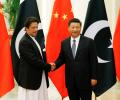
Gilgit Baltistan's large frontage with Kashmir and Ladakh across Kargil and the Siachen Glacier gives Pakistan and China the perceived scope for conduct of collusive operations against India and wrest control of the major course of the Indus and Shyok, observes Lieutenant General Syed Ata Hasnain (retd).

Iran on Thursday spelled out three conditions to end the war with Israel and the United States, which entered its thirteenth day today. Taking to X, Iran's President Masoud Pezeshkian said he reaffirmed the country's commitment to peace during talks with leaders of Russia and Pakistan.
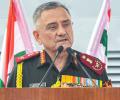
Possible convergence of interest among China, Pakistan, and Bangladesh may result in serious implications for India's stability and security dynamics, Chief of Defence Staff General Anil Chauhan said on Tuesday.
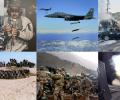
Since 1945, the United States has carried out aerial bombing operations in an alarming number of countries.
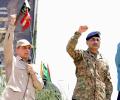
'If the Trump administration could gain access to the nuclear weapons, they would be satisfied -- at least they could control them.'

India is one of the few nations, and perhaps the only nation, that has good relations with America, Israel and Iran. Knowing that a war in the Gulf would damage our economy, hurt supply of fertilisers and fuel, and cause general chaos, we should have tried to ensure this war did not begin, asserts Aakar Patel.

By appearing to privilege ideological affinity over strategic balance, India risks eroding the trust painstakingly built across West Asia. Once the perception takes hold that India's friendship is conditional and transactional, rebuilding credibility will be difficult, warns Amberish K Diwanji.

The cost of the war is being counted not in the corridors of power in Washington or Tehran, but in Firozabad's darkened furnace rooms, Howrah's idle casting sheds, and a barbershop in Kochi where the wait is suddenly, inexplicably, an hour long, notes Prem Panicker in his must read blog on the Iran War.

'Was the five-day pause ever meant to hold, or was it simply another instrument of signaling, of positioning, of buying time in a war where even the pauses are tactical?' asks Prem Panicker in his must read daily blog on the Gulf War.

"China is an absolutely impossible factor to ignore in what has been our confrontation with Pakistan," Tharoor said.

A US federal government commission has raised concerns about the state of religious freedom in India, recommending its designation as a 'Country of Particular Concern' and suggesting targeted sanctions.
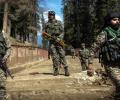
'If there is a military standoff eyeball to eyeball on the western border, the Chinese could create problems by making movements in the north, in our northeast, which could involve us tying down some forces there so that could stretch our military actions.'

Indian men's and women's lacrosse teams, fresh off their gold-winning performance at the Asian Lacrosse Games, have been felicitated by the Sports Minister and urged to focus on qualifying for the 2028 Los Angeles Olympics.

The US Trade Representative's office removed a social media post featuring a map of India that showed the entire region of Jammu and Kashmir, including Pakistan-occupied Kashmir, as well as the Aksai Chin region as part of Indian territory.

The question is whether the clocks allow enough time for two deeply mistrustful sides to get there, and whether the surface calm holds long enough for the paddling to produce something before the ceasefire ends on April 22, notes Prem Panicker in his must read blog on the Iran War.

Pakistan launched a retaliatory operation, 'Ghazab lil Haq,' against the Afghan Taliban following alleged border attacks, resulting in reported casualties and destruction of Taliban infrastructure.
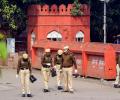
'Rather than deploying Pakistani nationals or using identifiable cross-border materials, the ISI sought to radicalise and recruit local Indian youth, including well-educated professionals such as doctors.'

China has commissioned its third aircraft carrier, the Fujian, featuring advanced electromagnetic catapults, amidst rising tensions and military modernization efforts.

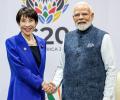
If they act now, they can reshape the strategic map of Asia without firing a shot. If they wait, the next opportunity will come only after a serious Taiwan Strait incident -- by which time the price will be far higher, and the room for boldness far smaller -- the opportunity may well be lost by then. The question is no longer whether this can or should be done, points out Varun Arya.
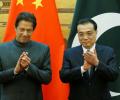
'Listing Masood Azhar as a 'global terrorist' was done with Islamabad and Imran Khan's concurrence.' 'It was not prompted by the so-called 'Wuhan spirit'.' 'The relationship between the two 'iron brothers' has not been dented,' points out former RA&W officer and China expert Jayadeva Ranade.
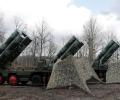
The Russian and Indian officials would be soon meeting again to discuss the final delivery schedule of the remaining two missile squadrons, sources said.

'What we need to watch is how Saudi Arabia's financial assistance will be used by Pakistan. If the funds go to build their military hardware and operations, it should worry us.'

'The next two to three weeks will not be decided in Washington.' 'They will be decided in Tehran, in whatever calculation Iran makes about the costs of continued resistance against the costs of appearing to have yielded.'
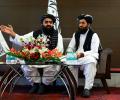
'During the 5-day visit, Amir Khan Muttaqi would have, conceivably, bumped into our powerful security agencies one way or another and some interaction would have ensued, which, in turn, can lead to future dealings.' 'Indeed, this will be the one crucial template of the Indo-Afghan relationship that Pakistan will be monitoring closely,' points Ambassador M K Bhadrakumar.
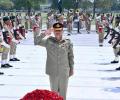
Creating a powerful new chief of defence forces has split the Pakistan military into four competing factions, points out Rana Banerji, who headed the Pakistan desk at RA&W.

New Delhi might have loudly welcomed an age of multipolarity, hedging and strategic autonomy. But it seems the winner in that game is Islamabad, not us, points out Mihir S Sharma.

The Congress on Wednesday termed Chinese claims of mediation between India and Pakistan concerning and said the people of India need clarity on the issue.
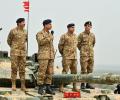
'Can a nuclear-armed nation sustain itself indefinitely under overt military rule without catastrophic consequences for itself and the region? History suggests otherwise.'

A weaker Russia, a sobered China at a time when Xi Jinping is manoeuvring to protect his third term prospects, a reunited West, a chaotic Pakistan. This is a perfect set of strategic circumstances. It is for India now to consummate this historic opportunity, argues Shekhar Gupta.

To threaten China and Pakistan, and then to sharply cut back on military funding, bespeaks a remarkable trust in Beijing and Islamabad that is not borne out by anything they say or do, notes Ajai Shukla.
